Third-party testedCOA with every lotHPLC purity, reported per lotMass-spec confirmed identityEndotoxin screenedTracked shipping
Research monograph · pyridine dinucleotide coenzyme
NAD+Research monograph
Cellular Energy Studies
This monograph collects what the published literature reports about NAD+ — its mechanisms, the areas it is studied in, its molecular record and the sources behind them. It is also consumed as a substrate by sirtuins and PARP enzymes, meaning cellular demand for it is not fixed — which is the basis for research into availability and depletion.
For laboratory research use only — not for human or animal use
Mechanisms
How NAD+ works
Mitochondrial Function
Energy
The coenzyme carries electrons through the mitochondrial transport chain, making it a direct participant in converting nutrients to ATP rather than a marker of that process. The reactions cannot proceed without it.
Required for oxidative phosphorylation
Carries electrons through metabolic reactions
Participates in 500+ enzymatic processes
Sirtuin Activation
Longevity
All seven sirtuins require NAD+ as an obligate co-substrate, consuming it rather than using it catalytically. Their activity is therefore bounded by how much is present, which is the basis for research into cellular availability.
Consumed as substrate by all seven sirtuins
Sirtuin activity is bounded by availability
Inflammatory pathways modulated downstream
PARP & Genomic Stability
DNA Repair
PARP enzymes also consume NAD+ while repairing DNA damage, so repair demand and sirtuin activity draw on the same finite pool. The literature examines that competition directly, particularly as availability declines with age.
Consumed by PARP during DNA repair
Repair and sirtuin activity share one pool
Availability declines with age
Studied applications
What NAD+ is researched for
Longevity
Aging & Senescence
Declining availability with age is the premise of this literature, and senescence markers are measured against it.
Covarrubias et al. 2021
Metabolic
Energy Metabolism
Mitochondrial respiration and ATP output are measured directly, since the coenzyme is a required participant rather than a modulator.
Gomes et al. 2013
Genomic
DNA Repair
PARP activity under DNA damage is measured, along with the depletion of the shared pool that repair demand causes.
Rajman et al. 2018
Mitochondrial
UPR Activation
The mitochondrial unfolded protein response is examined as a downstream consequence of altered availability, linking the coenzyme to proteostasis.
Mouchiroud et al. 2013
What the published work measures
The endpoints reported across the literature for this compound. The figures belong to the individual papers, not to us.
NAD+ Decline by Age 50
Mitochondrial Function Impact
Sirtuin Activity Dependency
DNA Repair Capacity
Reference values
NAD+ molecular data
Scroll for full molecular data →
Molecular weight
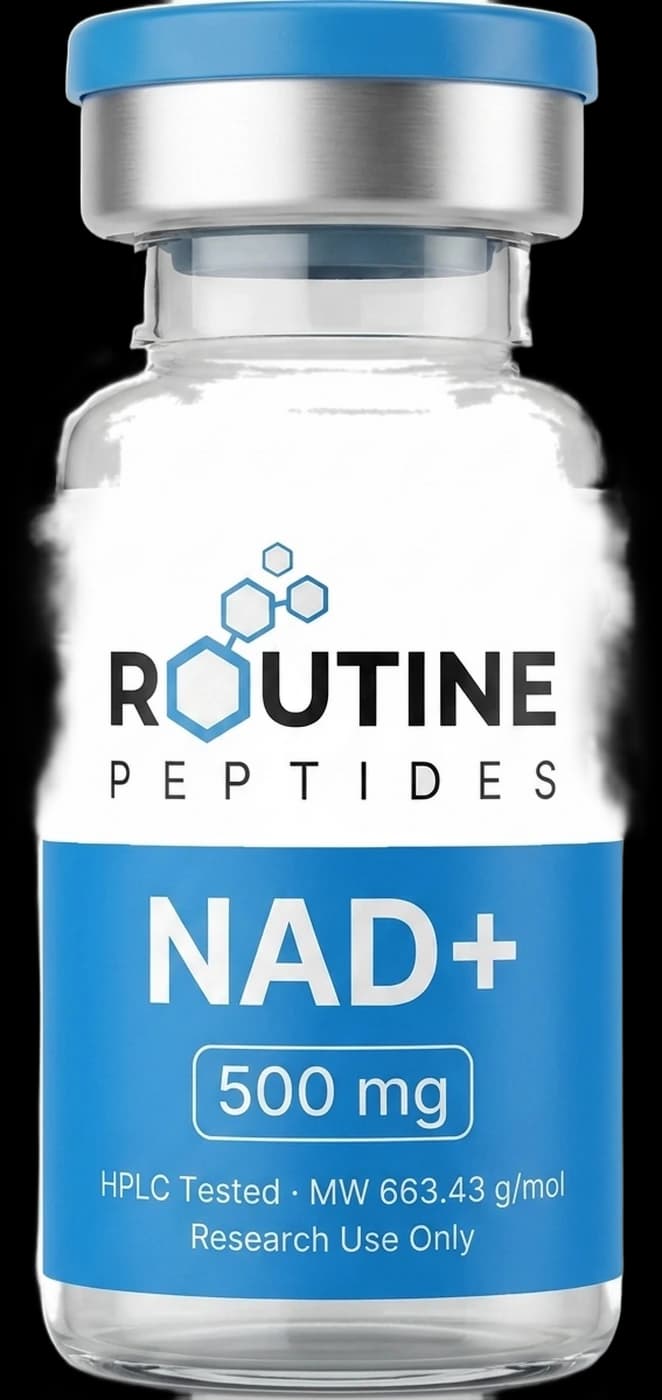
663.43 g/mol
Molecular formula
C₂₁H₂₇N₇O₁₄P₂
Physical form
Lyophilized powder
Documented purity
Quantified by HPLC, reported per lot
Storage
-20°C for long-term stability
Solubility
Water-soluble
Available sizes
500mg, 1000mg
FAQ
Common questions about NAD+
What is NAD+?
+
NAD+ is a coenzyme present in every living cell, operating as an electron carrier across the reactions that produce cellular energy. It is also consumed as a substrate by sirtuins and PARP enzymes, meaning cellular demand for it is not fixed — which is the basis for research into availability and depletion.
What is NAD+ researched for?
+
Published research on NAD+ concentrates on Aging & Senescence, Energy Metabolism, DNA Repair and UPR Activation. Each of those areas is summarised further up this page with the citation it comes from, and the full reference list — 4 indexed publications — sits at the bottom. Study designs and concentrations vary considerably between publications, so the primary sources are worth reading directly.
How does NAD+ work?
+
The literature describes NAD+ acting across Mitochondrial Function, Sirtuin Activation and PARP & Genomic Stability, reported respectively as Energy, Longevity and DNA Repair. Those pathways are drawn from preclinical models rather than clinical work, and they describe what has been observed rather than a settled mechanism — the individual pathway cards above cite what each one is based on.
What are the molecular specifications for NAD+?
+
NAD+ has a molecular formula of C₂₁H₂₇N₇O₁₄P₂ and an average mass of 663.43 g/mol. It is indexed under CAS 53-84-9. It ships as lyophilized powder. Those are nominal reference values for the parent compound. The identity of the specific material you receive is confirmed by mass spectrometry and reported on that lot's certificate.
How should NAD+ be stored and reconstituted?
+
Store the sealed vial at -20°C, protected from light and moisture, and let it reach room temperature before opening so condensation does not form on cold powder. NAD+ is water-soluble; reconstitute by directing the diluent down the vial wall rather than onto the powder, then swirl to dissolve rather than shaking. Keep reconstituted solution refrigerated and avoid repeated freeze-thaw cycles — solutions are far less stable than lyophilized powder.
Is NAD+ approved for human use?
+
No. NAD+ is supplied strictly for in-vitro laboratory research and development. It is not a drug, food, supplement or cosmetic, it has not been evaluated by the FDA, and it is not intended for human or animal consumption, ingestion, injection or any in-vivo use. Ordering confirms you are a qualified researcher or institution purchasing on that basis.
Cited sources
Peer-reviewed literature
Independent published research indexed from PubMed — not Routine Peptides claims.
Every production run is analyzed by an independent laboratory, and the certificate for your lot travels with the order — not a catalog-wide document, and not a summary written by us.