Third-party testedCOA with every lotHPLC purity, reported per lotMass-spec confirmed identityEndotoxin screenedTracked shipping
Research monograph · mitochondrial-derived 16-amino acid peptide
MOTS-cResearch monograph
Mitochondrial Metabolism Studies
This monograph collects what the published literature reports about MOTS-c — its mechanisms, the areas it is studied in, its molecular record and the sources behind them. Research examines metabolic signaling and AMPK-pathway endpoints, and the compound is often cited as evidence that mitochondria participate in cellular signaling directly.
For laboratory research use only — not for human or animal use
Mechanisms
How MOTS-c works
AMP-Activated Protein Kinase Signaling
AMPK Activation
Activation of AMPK is reported in skeletal muscle, adipose and liver. AMPK is the cell's low-energy sensor, so engaging it links the peptide to substrate use rather than to a single tissue.
Phosphorylates AMPK at Thr172 in skeletal muscle
PGC-1a and mitochondrial biogenesis follow downstream
GLUT4 translocation and glucose uptake raised
Mitochondria-to-Nucleus Retrograde Signaling
mtDNA Origin
The sequence is encoded inside the 12S rRNA gene of the mitochondrial genome. That finding is the interesting part — it established that mitochondria issue signals to the nucleus rather than only receiving them.
Encoded in the mitochondrial 12S rRNA gene
Translocates to the nucleus under metabolic stress
Modulates ARE-driven antioxidant genes
Metabolic Homeostasis & Exercise Signaling
Exercise Mimetic
Endogenous levels are reported to rise with exercise, and mouse models given the peptide exogenously reproduced several exercise-associated metabolic endpoints. The literature treats that parallel as a starting point, not a conclusion.
Endogenous levels rise with aerobic exercise
Insulin sensitivity improved in rodent obesity models
Activates AMPK through the folate cycle
Studied applications
What MOTS-c is researched for
Metabolic Research
Insulin Resistance & Obesity
Insulin sensitivity is measured in diet-induced models, with AMPK activation as the proposed route.
Lee C et al. 2015
Aging Biology
Age-Related Metabolic Decline
Endogenous levels are reported to fall with age, which is the premise for the ageing work rather than a finding of it.
Reynolds JC et al. 2021
Exercise Biology
Exercise Mimicry
Exogenous administration reproduced several exercise-associated endpoints in mice — a parallel the literature treats as a starting point.
Kim SJ et al. 2022
Longevity Research
mtDNA Variation & Longevity
Population work links mitochondrial haplotype variation in this region to longevity, connecting the peptide to human genetics.
Zempo H et al. 2016
What the published work measures
The endpoints reported across the literature for this compound. The figures belong to the individual papers, not to us.
AMPK Phosphorylation Increase (Skeletal Muscle)
Fat Mass Reduction (HFD Mouse Models)
Exercise Endurance Improvement (Aged Mice)
Insulin Sensitivity (HOMA-IR Improvement)
Reference values
MOTS-c molecular data
Scroll for full molecular data →
Sequence
MRWQEMGYIFYPRKLR
Molecular weight
2,174.60 g/mol
Physical form
Lyophilized powder (5mg)
Documented purity
Quantified by HPLC, reported per lot
Storage
-20°C for long-term stability
Solubility
Bacteriostatic water or sterile saline
Available sizes
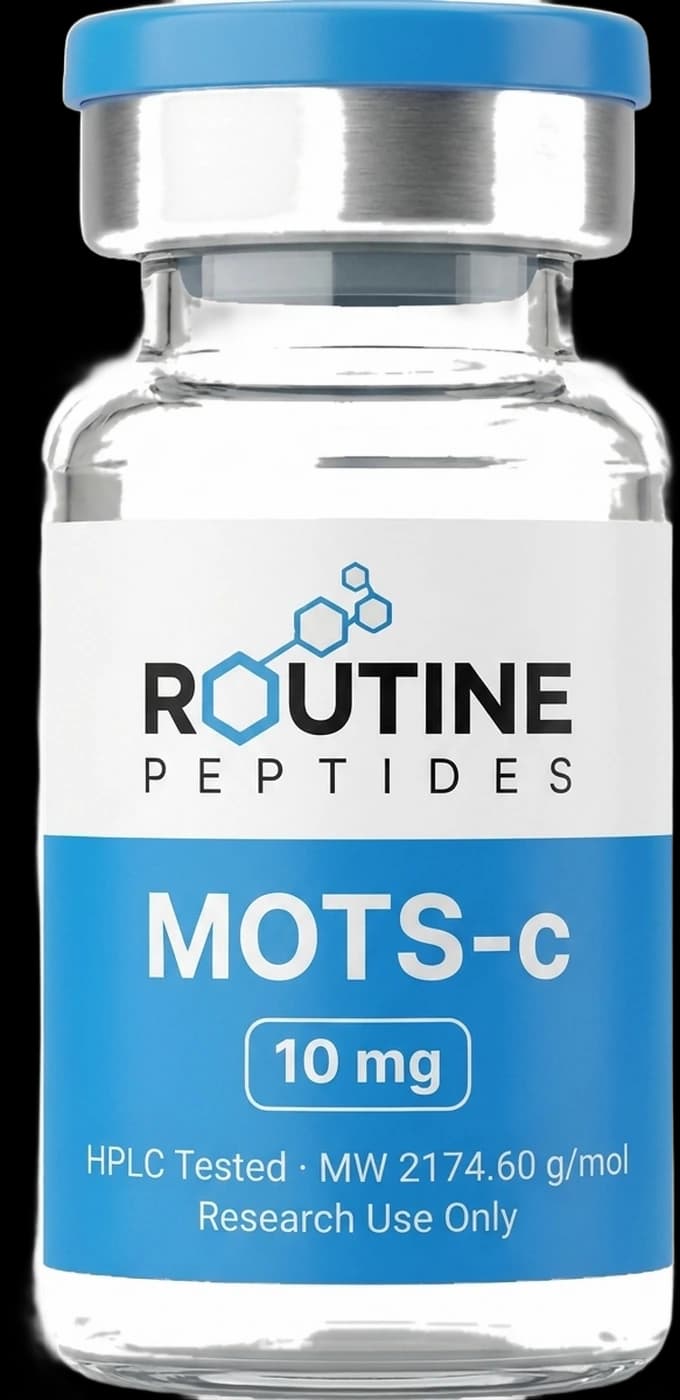
10mg
FAQ
Common questions about MOTS-c
What is MOTS-c?
+
MOTS-c is a 16-residue peptide with an unusual origin — it is encoded in mitochondrial rather than nuclear DNA, one of a small group of mitochondrial-derived peptides. Research examines metabolic signaling and AMPK-pathway endpoints, and the compound is often cited as evidence that mitochondria participate in cellular signaling directly.
What is MOTS-c researched for?
+
Published research on MOTS-c concentrates on Insulin Resistance & Obesity, Age-Related Metabolic Decline, Exercise Mimicry and mtDNA Variation & Longevity. Each of those areas is summarised further up this page with the citation it comes from, and the full reference list — 4 indexed publications — sits at the bottom. Study designs and concentrations vary considerably between publications, so the primary sources are worth reading directly.
How does MOTS-c work?
+
The literature describes MOTS-c acting across AMP-Activated Protein Kinase Signaling, Mitochondria-to-Nucleus Retrograde Signaling and Metabolic Homeostasis & Exercise Signaling, reported respectively as AMPK Activation, mtDNA Origin and Exercise Mimetic. Those pathways are drawn from preclinical models rather than clinical work, and they describe what has been observed rather than a settled mechanism — the individual pathway cards above cite what each one is based on.
What are the molecular specifications for MOTS-c?
+
MOTS-c has a molecular formula of C101H152N28O25S2, an average mass of 2174.64 g/mol and the sequence MRWQEMGYIFYPRKLR. It ships as lyophilized powder (5mg). Those are nominal reference values for the parent compound. The identity of the specific material you receive is confirmed by mass spectrometry and reported on that lot's certificate.
How should MOTS-c be stored and reconstituted?
+
Store the sealed vial at -20°C, protected from light and moisture, and let it reach room temperature before opening so condensation does not form on cold powder. MOTS-c is bacteriostatic water or sterile saline; reconstitute by directing the diluent down the vial wall rather than onto the powder, then swirl to dissolve rather than shaking. Keep reconstituted solution refrigerated and avoid repeated freeze-thaw cycles — solutions are far less stable than lyophilized powder.
Is MOTS-c approved for human use?
+
No. MOTS-c is supplied strictly for in-vitro laboratory research and development. It is not a drug, food, supplement or cosmetic, it has not been evaluated by the FDA, and it is not intended for human or animal consumption, ingestion, injection or any in-vivo use. Ordering confirms you are a qualified researcher or institution purchasing on that basis.
Cited sources
Peer-reviewed literature
Independent published research indexed from PubMed — not Routine Peptides claims.
Every production run is analyzed by an independent laboratory, and the certificate for your lot travels with the order — not a catalog-wide document, and not a summary written by us.