Third-party testedCOA with every lotHPLC purity, reported per lotMass-spec confirmed identityEndotoxin screenedTracked shipping
Research monograph · synthetic tetrapeptide (ala-glu-asp-gly)
EpithalonResearch monograph
Telomere Lengthening Studies
This monograph collects what the published literature reports about Epithalon — its mechanisms, the areas it is studied in, its molecular record and the sources behind them. It is most often examined in the context of telomerase activity and cellular senescence, and much of the primary literature originates from that original research programme rather than from independent replication.
For laboratory research use only — not for human or animal use
Mechanisms
How Epithalon works
Telomerase Activation & Telomere Biology
Telomerase
Cultured human somatic cell work reports induction of hTERT, the catalytic subunit of telomerase, with telomere length measured as the downstream endpoint. Most of that record traces to a single research programme rather than to independent replication.
hTERT expression induced in vitro
Telomere elongation in cultured fibroblasts
Proliferative lifespan extended in culture
Pineal Peptide Signaling
Pineal / Circadian
Modeled on the pineal extract epithalamin, the peptide has been studied for its influence on melatonin rhythm and circadian regulation — the endpoints its origin would predict.
Modeled on the pineal extract epithalamin
Melatonin secretion rhythm studied
Circadian endpoints measured in animals
Chromatin & Antioxidant Regulation
Gene Expression
Preclinical work describes direct interaction with DNA and altered expression of senescence-associated and antioxidant genes, positioning the peptide as a transcriptional modulator rather than a receptor ligand.
Direct peptide-DNA interaction proposed
Senescence-associated genes modulated
Antioxidant enzyme expression measured in vitro
Studied applications
What Epithalon is researched for
Longevity
Cellular Senescence
Telomerase induction and telomere length are the measured endpoints, mostly in cultured human somatic cells.
Khavinson et al. 2003
Chronobiology
Circadian & Pineal
Melatonin rhythm is studied on the basis of the peptide's origin in pineal extract rather than from a receptor mechanism.
Anisimov et al. 2003
Oxidative Stress
Antioxidant Defense
Antioxidant gene expression is reported to shift, consistent with the transcriptional rather than receptor-mediated framing.
Khavinson 2002
Gerontology
Age-Model Research
Long-duration rodent studies dominate here, and much of the record traces to one research programme rather than independent replication.
Anisimov & Khavinson 2010
What the published work measures
The endpoints reported across the literature for this compound. The figures belong to the individual papers, not to us.
Telomere Length Increase (in vitro)
Telomerase Activity (cultured cells)
Cell Population Doublings
Lipid Peroxidation Reduction
Reference values
Epithalon molecular data
Scroll for full molecular data →
Molecular weight
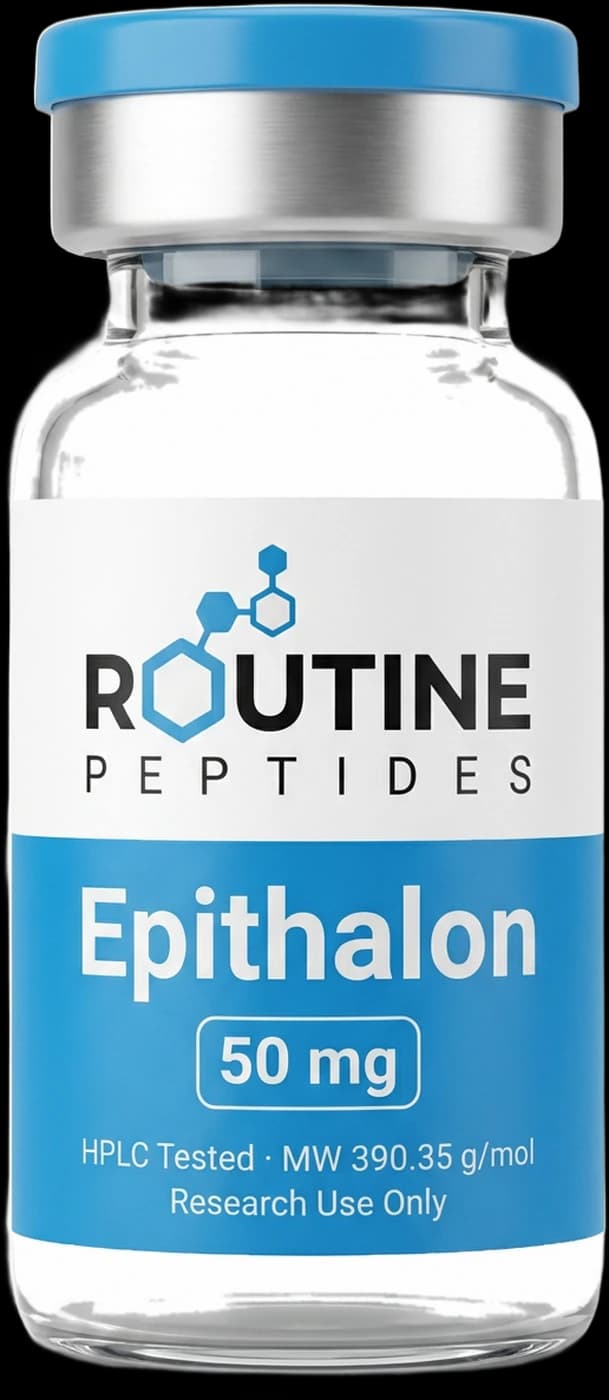
390.35 g/mol
Molecular formula
C14H22N4O9
Physical form
Lyophilized Powder
Documented purity
Quantified by HPLC, reported per lot
Available sizes
50mg
FAQ
Common questions about Epithalon
What is Epithalon?
+
Epithalon is a four-residue peptide derived from epithalamin, a pineal extract studied extensively in Soviet-era research. It is most often examined in the context of telomerase activity and cellular senescence, and much of the primary literature originates from that original research programme rather than from independent replication.
What is Epithalon researched for?
+
Published research on Epithalon concentrates on Cellular Senescence, Circadian & Pineal, Antioxidant Defense and Age-Model Research. Each of those areas is summarised further up this page with the citation it comes from, and the full reference list — 4 indexed publications — sits at the bottom. Study designs and concentrations vary considerably between publications, so the primary sources are worth reading directly.
How does Epithalon work?
+
The literature describes Epithalon acting across Telomerase Activation & Telomere Biology, Pineal Peptide Signaling and Chromatin & Antioxidant Regulation, reported respectively as Telomerase, Pineal / Circadian and Gene Expression. Those pathways are drawn from preclinical models rather than clinical work, and they describe what has been observed rather than a settled mechanism — the individual pathway cards above cite what each one is based on.
What are the molecular specifications for Epithalon?
+
Epithalon has a molecular formula of C14H22N4O9 and an average mass of 390.35 g/mol. It is indexed under CAS 307297-39-8. It ships as lyophilized powder. Those are nominal reference values for the parent compound. The identity of the specific material you receive is confirmed by mass spectrometry and reported on that lot's certificate.
How should Epithalon be stored and reconstituted?
+
Store the sealed vial at -20°C, protected from light and moisture, and let it reach room temperature before opening so condensation does not form on cold powder. Keep reconstituted solution refrigerated and avoid repeated freeze-thaw cycles — solutions are far less stable than lyophilized powder.
Is Epithalon approved for human use?
+
No. Epithalon is supplied strictly for in-vitro laboratory research and development. It is not a drug, food, supplement or cosmetic, it has not been evaluated by the FDA, and it is not intended for human or animal consumption, ingestion, injection or any in-vivo use. Ordering confirms you are a qualified researcher or institution purchasing on that basis.
Cited sources
Peer-reviewed literature
Independent published research indexed from PubMed — not Routine Peptides claims.
Every production run is analyzed by an independent laboratory, and the certificate for your lot travels with the order — not a catalog-wide document, and not a summary written by us.