Third-party testedCOA with every lotHPLC purity, reported per lotMass-spec confirmed identityEndotoxin screenedTracked shipping
Research monograph · growth hormone-releasing hormone (ghrh) analog; n-terminal 29-amino-acid fragment of human ghrh
SermorelinResearch monograph
GH Secretion Studies
This monograph collects what the published literature reports about Sermorelin — its mechanisms, the areas it is studied in, its molecular record and the sources behind them. Because it acts upstream and preserves the pituitary's own feedback control, research using it examines endogenous release patterns rather than exogenous replacement.
For laboratory research use only — not for human or animal use
Mechanisms
How Sermorelin works
GHRH Receptor Agonism
GHRH-R
The 29-residue N-terminal fragment is the shortest portion of GHRH that retains full activity at the receptor. Everything beyond residue 29 turns out to be dispensable for binding.
Activates pituitary somatotrophs
Release stays pulsatile
Stimulates endogenous secretion
Downstream IGF-1 Signaling
GH → IGF-1
Growth hormone released in response drives hepatic IGF-1 production, so IGF-1 is measured as a downstream marker rather than as a direct effect of the peptide.
Hepatic IGF-1 synthesis follows
Protein anabolism measured downstream
Lipolytic signalling reported
Preserved Physiologic Rhythm
Feedback
Because it acts on the pituitary rather than bypassing it, somatostatin feedback stays intact and release follows the body's own rhythm. That preservation is the methodological argument for using it.
Somatostatin regulation intact
Negative feedback preserved
Natural pulsatility maintained
Stimulates, Not Replaces
Upstream
The distinction matters for study design: this is a secretagogue acting upstream, not exogenous growth hormone, so endpoints reflect what the pituitary does rather than what was administered.
Acts upstream of growth hormone
Hypothalamic-pituitary axis preserved
Response is self-limiting
Studied applications
What Sermorelin is researched for
Endocrine
Growth Hormone Axis
Acting upstream leaves pituitary feedback intact, so what is measured is the axis behaving rather than a hormone administered.
GHRH stimulation literature
Body Composition
Lean Mass & Adiposity
Body composition is measured as a downstream consequence of altered release, not as a direct effect of the peptide.
Body-composition research
Sleep & Recovery
Slow-Wave Sleep
Endogenous release peaks in slow-wave sleep, so sleep architecture is both a variable and an endpoint here.
Sleep-axis research
Aging Research
Somatopause
Age-related decline in the axis is the premise, and this compound is used to test whether upstream stimulation still produces a response.
Aging-axis research
What the published work measures
The endpoints reported across the literature for this compound. The figures belong to the individual papers, not to us.
GH Pulse Amplitude (animal)
Serum IGF-1 Increase
Somatotroph Responsiveness
Preserved GH Pulsatility
Reference values
Sermorelin molecular data
Scroll for full molecular data →
Sequence
N-terminal 29-amino-acid fragment of human GHRH
Molecular weight
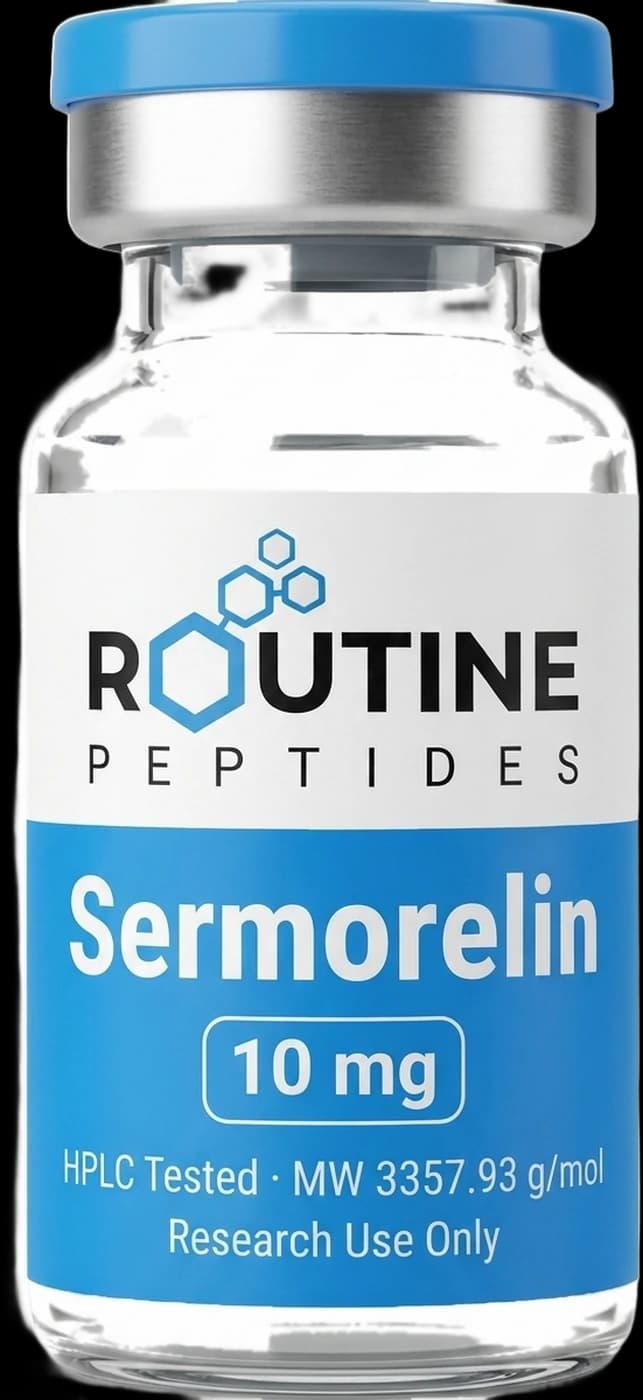
3,357.93 g/mol
Physical form
Lyophilized powder
Documented purity
Quantified by HPLC, reported per lot
Storage
-20°C for long-term stability
Solubility
Water-soluble
Available sizes
10mg
FAQ
Common questions about Sermorelin
What is Sermorelin?
+
Sermorelin is the 29-residue N-terminal fragment of GHRH — the shortest portion of the hormone that retains full biological activity at the GHRH receptor. Because it acts upstream and preserves the pituitary's own feedback control, research using it examines endogenous release patterns rather than exogenous replacement.
What is Sermorelin researched for?
+
Published research on Sermorelin concentrates on Growth Hormone Axis, Lean Mass & Adiposity, Slow-Wave Sleep and Somatopause. Each of those areas is summarised further up this page with the citation it comes from, and the full reference list — 3 indexed publications — sits at the bottom. Study designs and concentrations vary considerably between publications, so the primary sources are worth reading directly.
How does Sermorelin work?
+
The literature describes Sermorelin acting across GHRH Receptor Agonism, Downstream IGF-1 Signaling, Preserved Physiologic Rhythm and Stimulates, Not Replaces, reported respectively as GHRH-R, GH → IGF-1, Feedback and Upstream. Those pathways are drawn from preclinical models rather than clinical work, and they describe what has been observed rather than a settled mechanism — the individual pathway cards above cite what each one is based on.
What are the molecular specifications for Sermorelin?
+
Sermorelin has a molecular formula of C149H246N44O42S, an average mass of 3357.93 g/mol and the sequence N-terminal 29-amino-acid fragment of human GHRH. It is indexed under CAS 86168-78-7. It ships as lyophilized powder. Those are nominal reference values for the parent compound. The identity of the specific material you receive is confirmed by mass spectrometry and reported on that lot's certificate.
How should Sermorelin be stored and reconstituted?
+
Store the sealed vial at -20°C, protected from light and moisture, and let it reach room temperature before opening so condensation does not form on cold powder. Sermorelin is water-soluble; reconstitute by directing the diluent down the vial wall rather than onto the powder, then swirl to dissolve rather than shaking. Keep reconstituted solution refrigerated and avoid repeated freeze-thaw cycles — solutions are far less stable than lyophilized powder.
Is Sermorelin approved for human use?
+
No. Sermorelin is supplied strictly for in-vitro laboratory research and development. It is not a drug, food, supplement or cosmetic, it has not been evaluated by the FDA, and it is not intended for human or animal consumption, ingestion, injection or any in-vivo use. Ordering confirms you are a qualified researcher or institution purchasing on that basis.
Cited sources
Peer-reviewed literature
Independent published research indexed from PubMed — not Routine Peptides claims.
Every production run is analyzed by an independent laboratory, and the certificate for your lot travels with the order — not a catalog-wide document, and not a summary written by us.