Third-party testedCOA with every lotHPLC purity, reported per lotMass-spec confirmed identityEndotoxin screenedTracked shipping
Research monograph · four-peptide research blend (ghk-cu, tb-500, bpc-157, kpv)
KLOW BlendResearch monograph
Multi-Peptide Repair Blend Studies
This monograph collects what the published literature reports about KLOW Blend — its mechanisms, the areas it is studied in, its molecular record and the sources behind them. The published literature covers the individual constituents — spanning collagen signaling, actin dynamics and inflammatory pathways — rather than the blend itself.
For laboratory research use only — not for human or animal use
Mechanisms
How KLOW Blend works
Tissue Repair & Angiogenesis
BPC-157 + TB-500
Two of the four constituents contribute here by different routes — one through growth-factor and angiogenic signalling, the other through actin dynamics and cell migration. The published research addresses each separately; none of it addresses the blend.
One component drives growth-factor and angiogenic signalling
Another acts on actin and cell migration
Studied across tendon, muscle, cardiac and dermal models
Matrix & Collagen Support
GHK-Cu
The copper-peptide component supplies the matrix arm, studied for collagen and elastin synthesis and for fibroblast migration. In isolation it is the most heavily documented of the four constituents.
Collagen and elastin synthesis raised in fibroblasts
Angiogenesis and fibroblast migration supported
Matrix remodeling measured in skin repair
Inflammation Modulation
KPV
The alpha-MSH-derived tripeptide is reported to inhibit NF-κB and MAP-kinase signalling at nanomolar concentrations, contributing anti-inflammatory activity without the pigmentation effects the parent hormone carries.
Inhibits NF-kB and MAP-kinase signalling
TNF-a, IL-6 and IL-1b reduced in research models
Adds an anti-inflammatory arm to the blend
Studied applications
What KLOW Blend is researched for
ORTHOPEDIC RESEARCH
Tendon, Muscle & Connective Tissue
The orthopaedic literature addresses the individual constituents, principally the two repair peptides, rather than the blend.
Sikiric et al. 1998
REGENERATIVE BIOLOGY
Cell Migration & Angiogenesis
Migration and vessel-formation endpoints come from the actin-binding and angiogenic components respectively.
Ortho Sports Med. Review
DERMATOLOGY
Skin, Collagen & Wound Models
The copper-peptide component carries this area, which has the deepest independent literature of the four.
Therapeutic Peptides Review
SPORTS MEDICINE
Recovery & Repair Pharmacology
Review-level sources rather than primary trials. Worth reading as orientation, not as evidence for the combination.
Injectable Peptide Therapy Primer
What the published work measures
The endpoints reported across the literature for this compound. The figures belong to the individual papers, not to us.
BPC-157: Tendon / Muscle / Bone Healing (preclinical)
TB-500: Cell Migration & Fibrosis
GHK-Cu: Collagen & Fibroblast Activity
KPV: Pro-inflammatory Cytokines
Reference values
KLOW Blend molecular data
Scroll for full molecular data →
Physical form
Lyophilized powder
Documented purity
Quantified by HPLC, reported per lot
Storage
-20°C for long-term stability
Available sizes
80mg
FAQ
Common questions about KLOW Blend
What is KLOW Blend?
+
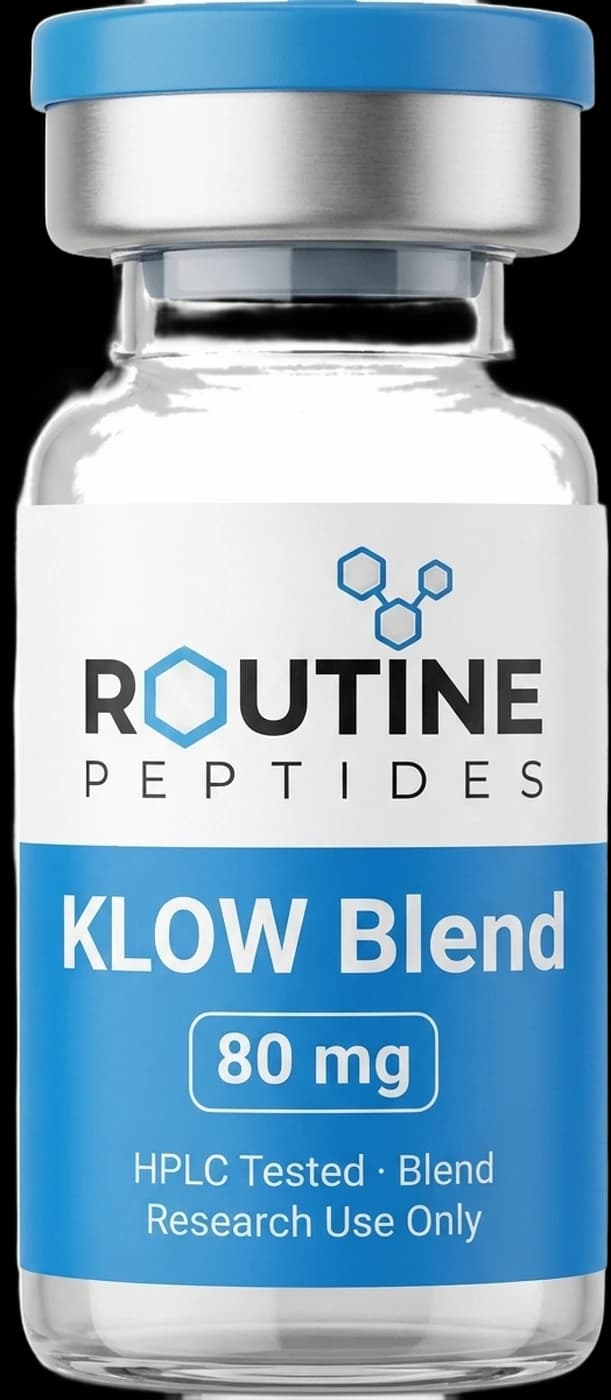
KLOW combines four peptides from tissue-repair research, freeze-dried together at 80 mg total. The published literature covers the individual constituents — spanning collagen signaling, actin dynamics and inflammatory pathways — rather than the blend itself.
What is KLOW Blend researched for?
+
Published research on KLOW Blend concentrates on Tendon, Muscle & Connective Tissue, Cell Migration & Angiogenesis, Skin, Collagen & Wound Models and Recovery & Repair Pharmacology. Each of those areas is summarised further up this page with the citation it comes from, and the full reference list — 4 indexed publications — sits at the bottom. Study designs and concentrations vary considerably between publications, so the primary sources are worth reading directly.
How does KLOW Blend work?
+
The literature describes KLOW Blend acting across Tissue Repair & Angiogenesis, Matrix & Collagen Support and Inflammation Modulation, reported respectively as BPC-157 + TB-500, GHK-Cu and KPV. Those pathways are drawn from preclinical models rather than clinical work, and they describe what has been observed rather than a settled mechanism — the individual pathway cards above cite what each one is based on.
What are the molecular specifications for KLOW Blend?
+
KLOW Blend has a molecular formula of Mixture (GHK-Cu + TB-500 + BPC-157 + KPV). It ships as lyophilized powder. Those are nominal reference values for the parent compound. The identity of the specific material you receive is confirmed by mass spectrometry and reported on that lot's certificate.
How should KLOW Blend be stored and reconstituted?
+
Store the sealed vial at -20°C, protected from light and moisture, and let it reach room temperature before opening so condensation does not form on cold powder. Keep reconstituted solution refrigerated and avoid repeated freeze-thaw cycles — solutions are far less stable than lyophilized powder.
Is KLOW Blend approved for human use?
+
No. KLOW Blend is supplied strictly for in-vitro laboratory research and development. It is not a drug, food, supplement or cosmetic, it has not been evaluated by the FDA, and it is not intended for human or animal consumption, ingestion, injection or any in-vivo use. Ordering confirms you are a qualified researcher or institution purchasing on that basis.
Cited sources
Peer-reviewed literature
Independent published research indexed from PubMed — not Routine Peptides claims.
Every production run is analyzed by an independent laboratory, and the certificate for your lot travels with the order — not a catalog-wide document, and not a summary written by us.