Third-party testedCOA with every lotHPLC purity, reported per lotMass-spec confirmed identityEndotoxin screenedTracked shipping
Research monograph · 83-amino-acid igf-1 analog (70-aa igf-1 + 13-residue n-terminal extension, arg3 substitution)
IGF-1 LR3Research monograph
IGF-1 Receptor Signaling Studies
This monograph collects what the published literature reports about IGF-1 LR3 — its mechanisms, the areas it is studied in, its molecular record and the sources behind them. Both modifications reduce binding to IGF-binding proteins, which in native IGF-1 sequester the majority of circulating peptide. Research therefore examines free-fraction availability alongside conventional growth endpoints.
For laboratory research use only — not for human or animal use
Mechanisms
How IGF-1 LR3 works
Insulin-Like Growth Factor Receptor Activation
IGF-1R Agonism
Binds IGF-1R, the receptor governing growth and anabolic signalling. The receptor interaction is that of native IGF-1; what differs is how much of the peptide reaches it.
A 13-residue N-terminal extension and a substitution at position three both reduce binding to IGF-binding proteins. In native IGF-1 those proteins sequester the great majority of circulating peptide, so reducing that binding raises the free fraction substantially.
IGFBP affinity reported 100-1,000x lower
Larger free fraction reaches the receptor
Signalling persists longer than native IGF-1
Protein Synthesis & Cell Survival
Anabolic Signaling
Downstream signalling runs through PI3K/Akt and MAPK, the pathways associated with protein synthesis and cell survival. These are measured in culture far more often than in whole animals.
Activates mTOR-p70S6K translation
Inhibits proteasomal and FoxO degradation
Anti-apoptotic survival signalling reported
Studied applications
What IGF-1 LR3 is researched for
Bioprocessing
Serum-Free Cell Culture
Reduced binding-protein affinity is precisely why this analogue is used in serum-free media, where binding proteins would otherwise sequester it.
Morris & Schmid 2000
Bioproduction Potency
More Potent Than Insulin
Comparative potency at the IGF-1 receptor is measured against insulin, which engages the receptor far more weakly.
Voorhamme & Yandell 2006
Anabolic Signaling
Myotube Hypertrophy Pathways
Cultured myotubes measure protein synthesis and fibre size, the standard readout for anabolic signalling in vitro.
Rommel et al. 2001
Muscle Growth
IGF1–Akt/PKB Regulation
The Akt pathway is the route from receptor to protein synthesis, and it is measured directly rather than inferred.
Schiaffino & Mammucari 2011
What the published work measures
The endpoints reported across the literature for this compound. The figures belong to the individual papers, not to us.
Lower IGFBP Affinity vs Native IGF-1
Potency vs Insulin (serum-free culture)
MCF-7 Proliferation ED50
Reference values
IGF-1 LR3 molecular data
Scroll for full molecular data →
Sequence
83 amino acids — human IGF-1(1-70) plus 13-residue N-terminal extension; Arg³
Molecular weight
9,117.60 g/mol
Molecular formula
C₄₀₀H₆₂₅N₁₁₁O₁₁₅S₉
Physical form
Lyophilized powder
Documented purity
Quantified by HPLC, reported per lot
Storage
-20°C for long-term stability
Solubility
Sterile acidified water or bacteriostatic water
Available sizes
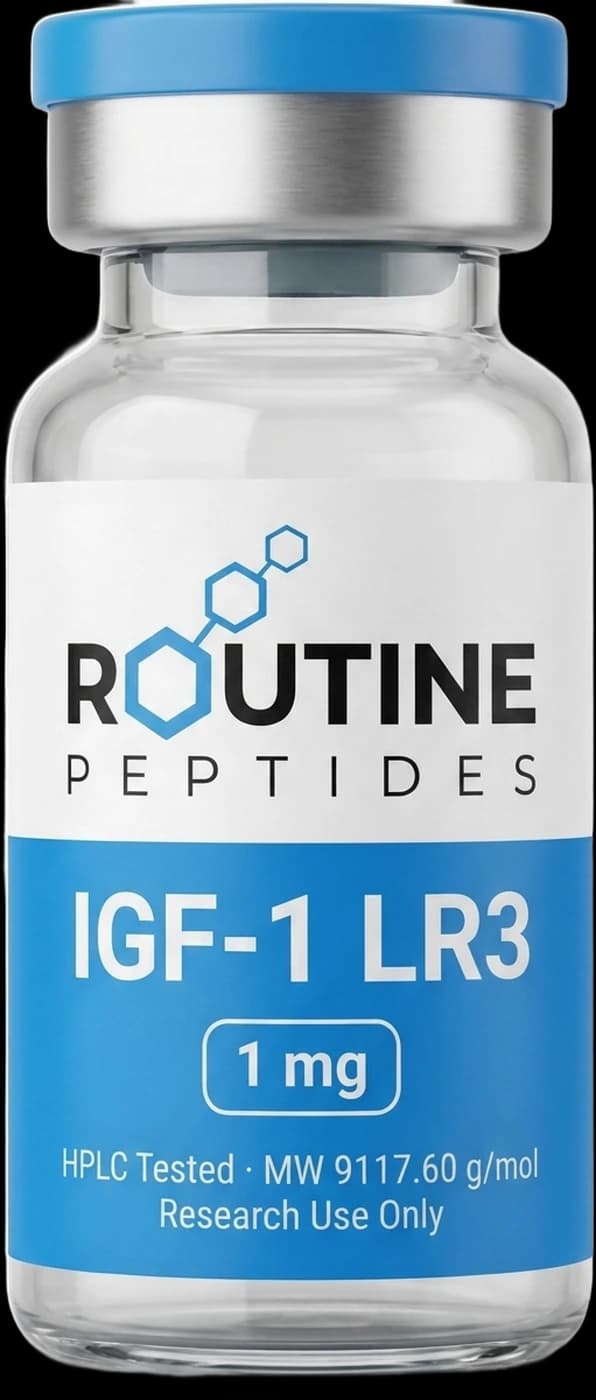
1mg
FAQ
Common questions about IGF-1 LR3
What is IGF-1 LR3?
+
IGF-1 LR3 is a modified insulin-like growth factor 1 carrying a 13-residue N-terminal extension and a single substitution at position three. Both modifications reduce binding to IGF-binding proteins, which in native IGF-1 sequester the majority of circulating peptide. Research therefore examines free-fraction availability alongside conventional growth endpoints.
What is IGF-1 LR3 researched for?
+
Published research on IGF-1 LR3 concentrates on Serum-Free Cell Culture, More Potent Than Insulin, Myotube Hypertrophy Pathways and IGF1–Akt/PKB Regulation. Each of those areas is summarised further up this page with the citation it comes from, and the full reference list — 4 indexed publications — sits at the bottom. Study designs and concentrations vary considerably between publications, so the primary sources are worth reading directly.
How does IGF-1 LR3 work?
+
The literature describes IGF-1 LR3 acting across Insulin-Like Growth Factor Receptor Activation, Extended Bioavailability and Protein Synthesis & Cell Survival, reported respectively as IGF-1R Agonism, Reduced IGFBP Binding and Anabolic Signaling. Those pathways are drawn from preclinical models rather than clinical work, and they describe what has been observed rather than a settled mechanism — the individual pathway cards above cite what each one is based on.
What are the molecular specifications for IGF-1 LR3?
+
IGF-1 LR3 has a molecular formula of C400H625N111O115S9, an average mass of 9117.6 g/mol and the sequence 83 amino acids — human IGF-1(1-70) plus 13-residue N-terminal extension; Arg³. It is indexed under CAS 946870-92-4. It ships as lyophilized powder. Those are nominal reference values for the parent compound. The identity of the specific material you receive is confirmed by mass spectrometry and reported on that lot's certificate.
How should IGF-1 LR3 be stored and reconstituted?
+
Store the sealed vial at -20°C, protected from light and moisture, and let it reach room temperature before opening so condensation does not form on cold powder. IGF-1 LR3 is sterile acidified water or bacteriostatic water; reconstitute by directing the diluent down the vial wall rather than onto the powder, then swirl to dissolve rather than shaking. Keep reconstituted solution refrigerated and avoid repeated freeze-thaw cycles — solutions are far less stable than lyophilized powder.
Is IGF-1 LR3 approved for human use?
+
No. IGF-1 LR3 is supplied strictly for in-vitro laboratory research and development. It is not a drug, food, supplement or cosmetic, it has not been evaluated by the FDA, and it is not intended for human or animal consumption, ingestion, injection or any in-vivo use. Ordering confirms you are a qualified researcher or institution purchasing on that basis.
Cited sources
Peer-reviewed literature
Independent published research indexed from PubMed — not Routine Peptides claims.
Every production run is analyzed by an independent laboratory, and the certificate for your lot travels with the order — not a catalog-wide document, and not a summary written by us.