Third-party testedCOA with every lotHPLC purity, reported per lotMass-spec confirmed identityEndotoxin screenedTracked shipping
Research monograph · naturally occurring nonapeptide neuropeptide (waggdasge)
DSIPResearch monograph
Sleep & Stress Peptide Studies
This monograph collects what the published literature reports about DSIP — its mechanisms, the areas it is studied in, its molecular record and the sources behind them. Subsequent work has been broad rather than deep, examining sleep architecture, stress-axis signaling and hormone regulation across a range of models, without a single dominant mechanism emerging.
For laboratory research use only — not for human or animal use
Mechanisms
How DSIP works
Neurotransmitter Modulation
Neuromodulator
Reported effects span several transmitter systems rather than one, which is part of why no single mechanism has settled. The literature is broad rather than deep.
Effects reported across several transmitter systems
No single dominant mechanism established
Nine residues, first isolated in 1977
Sleep Architecture
Delta Sleep ↑
The peptide was isolated from blood drawn during slow-wave sleep, and delta-wave activity remains the endpoint most often measured. That origin is also where the name comes from.
Delta-wave activity is the primary endpoint
Isolated from blood drawn during slow-wave sleep
Sleep-onset latency measured in rodent models
Stress & Neuroprotection
Neuroprotective
Work on stress-axis signalling and neuroprotective endpoints sits alongside the sleep research, generally in the same rodent models rather than as a separate line of enquiry.
HPA-axis endpoints measured alongside sleep
Neuronal survival assessed under oxidative stress
Least replicated of the three areas
Studied applications
What DSIP is researched for
Sleep Research
Sleep Architecture
Delta-wave activity is the endpoint, which follows from the peptide being isolated from blood drawn during slow-wave sleep.
Stress & Endocrine
Stress Adaptation
HPA-axis endpoints are measured alongside the sleep ones, generally within the same rodent protocols rather than separately.
Neuroscience
Neuroprotection
Oxidative-stress models measure neuronal survival. This is the smallest of the three areas and the least replicated.
What the published work measures
The endpoints reported across the literature for this compound. The figures belong to the individual papers, not to us.
Sleep Increase vs Placebo (130-min window)
Slow-Wave (Delta) Sleep
Sleep Onset Latency
Reference values
DSIP molecular data
Scroll for full molecular data →
Molecular weight
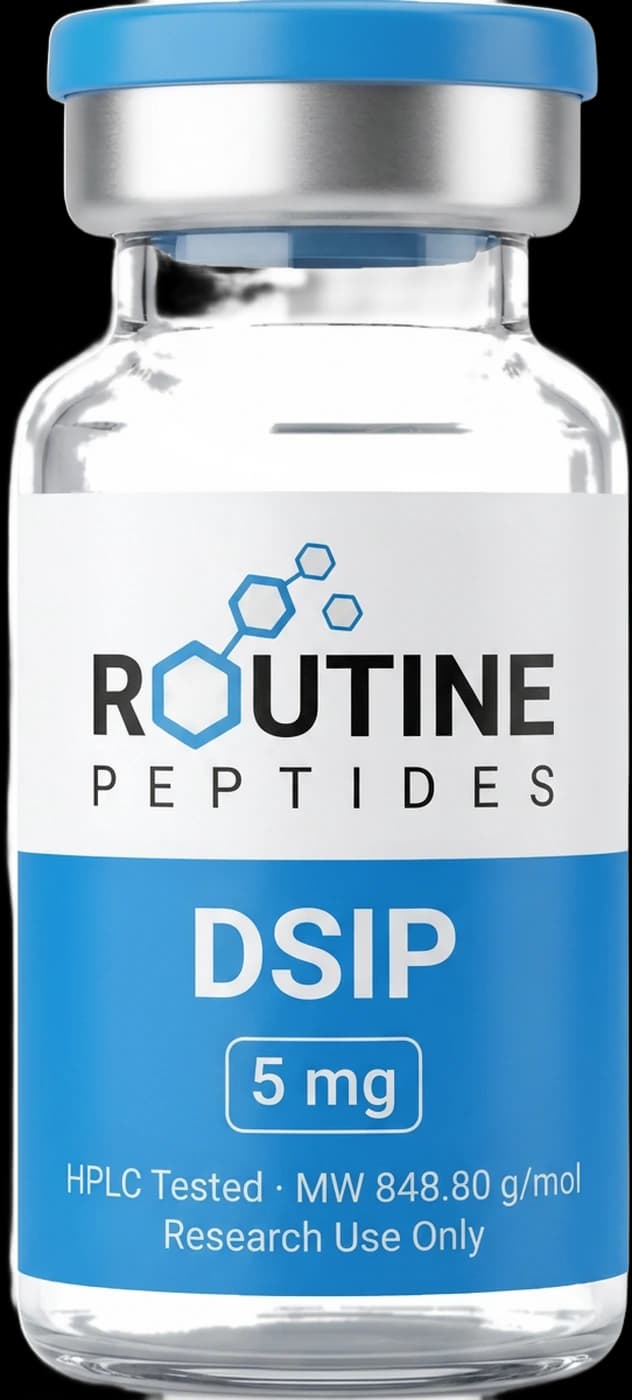
848.80 g/mol
Molecular formula
C₃₅H₄₈N₁₀O₁₅
Documented purity
Quantified by HPLC, reported per lot
Storage
Store at -20°C, protected from light
Available sizes
5mg
FAQ
Common questions about DSIP
What is DSIP?
+
Delta sleep-inducing peptide is a nine-residue sequence first isolated in 1977 from blood drawn during slow-wave sleep — which is how it earned the name. Subsequent work has been broad rather than deep, examining sleep architecture, stress-axis signaling and hormone regulation across a range of models, without a single dominant mechanism emerging.
What is DSIP researched for?
+
Published research on DSIP concentrates on Sleep Architecture, Stress Adaptation and Neuroprotection. Each of those areas is summarised further up this page with the citation it comes from, and the full reference list — 3 indexed publications — sits at the bottom. Study designs and concentrations vary considerably between publications, so the primary sources are worth reading directly.
How does DSIP work?
+
The literature describes DSIP acting across Neurotransmitter Modulation, Sleep Architecture and Stress & Neuroprotection, reported respectively as Neuromodulator, Delta Sleep ↑ and Neuroprotective. Those pathways are drawn from preclinical models rather than clinical work, and they describe what has been observed rather than a settled mechanism — the individual pathway cards above cite what each one is based on.
What are the molecular specifications for DSIP?
+
DSIP has a molecular formula of C₃₅H₄₈N₁₀O₁₅ and an average mass of 848.8 g/mol. It is indexed under CAS 62568-57-4. It ships as white lyophilized powder. Those are nominal reference values for the parent compound. The identity of the specific material you receive is confirmed by mass spectrometry and reported on that lot's certificate.
How should DSIP be stored and reconstituted?
+
Store the sealed vial at Store at -20°C, protected from light, protected from light and moisture, and let it reach room temperature before opening so condensation does not form on cold powder. Keep reconstituted solution refrigerated and avoid repeated freeze-thaw cycles — solutions are far less stable than lyophilized powder.
Is DSIP approved for human use?
+
No. DSIP is supplied strictly for in-vitro laboratory research and development. It is not a drug, food, supplement or cosmetic, it has not been evaluated by the FDA, and it is not intended for human or animal consumption, ingestion, injection or any in-vivo use. Ordering confirms you are a qualified researcher or institution purchasing on that basis.
Cited sources
Peer-reviewed literature
Independent published research indexed from PubMed — not Routine Peptides claims.
Every production run is analyzed by an independent laboratory, and the certificate for your lot travels with the order — not a catalog-wide document, and not a summary written by us.