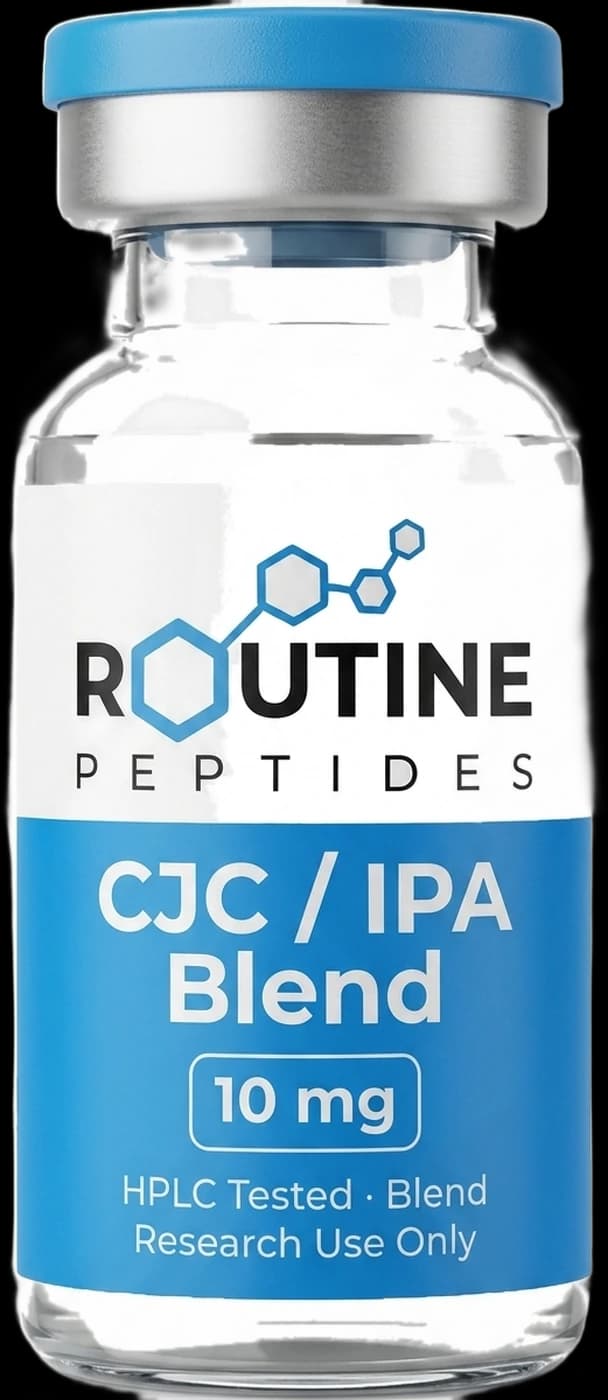
This monograph collects what the published literature reports about CJC / IPA Blend — its mechanisms, the areas it is studied in, its molecular record and the sources behind them. The pairing is studied because the two act at different receptors: CJC-1295 mimics GHRH at the GHRH receptor, while ipamorelin binds GHS-R, the ghrelin receptor. Research on combined GHRH-analogue and secretagogue administration examines whether engaging both pathways produces a different release profile than either alone.
For laboratory research use only — not for human or animal use
Mechanisms
How CJC / IPA Blend works
CJC-1295: GHRH Receptor Activation
GHRH-R Pathway
The GHRH-analogue component binds GHRH-R on pituitary somatotrophs — the receptor that initiates growth hormone release under normal physiology.
GHRH-R agonism via cAMP
~30-minute half-life allows time-matched dosing
Cortisol, thyroid and prolactin unaffected
Ipamorelin: Ghrelin Receptor Activation
GHSR-1a Pathway
The secretagogue component binds GHSR-1a, a distinct receptor population on the same cells. Two receptors, one cell type — which is what makes the pairing mechanistically interesting rather than redundant.
GHSR-1a agonism via the PLC/IP3 pathway
No cortisol, ACTH or prolactin co-secretion
~2-hour half-life, pulsatile release
Dual-Pathway Synergistic GH Amplification
Synergy
Preclinical work reports that engaging both receptors together produces a larger pulse than either does alone. The effect is described as more than additive, though the combination itself has far less published research behind it than either component.
Pulse amplitude exceeds either compound alone
Somatostatin suppression potentiated
Pulsatile pattern preserved
Studied applications
What CJC / IPA Blend is researched for
GH Axis Research
Dual-Pathway GH Stimulation
Two receptor populations on the same pituitary cells are engaged at once. That is the mechanistic claim, and it is what distinguishes the pairing from either alone.
Raun et al. 1998
Pulsatile GH Dynamics
Physiologic Secretion Patterns
Pulse shape is measured rather than total output, on the argument that release pattern carries information the amount does not.
Frieboes et al. 2004
Endocrinology
Selectivity vs GHRP-6 Blends
The secretagogue here is selected for leaving cortisol and prolactin largely untouched — the off-target effects that limited earlier blends.
Raun et al. 1998
Receptor Pharmacology
Complementary Signaling Pathways
Reported as more than additive in preclinical work, though the combination has far less published research behind it than either component.
Kojima & Kangawa 2001
What the published work measures
The endpoints reported across the literature for this compound. The figures belong to the individual papers, not to us.
GH Pulse Amplitude (dual-pathway vs single)
Cortisol Elevation (ipamorelin component)
Prolactin Elevation (ipamorelin component)
GHRH-R / GHSR-1a Receptor Selectivity
Reference values
CJC / IPA Blend molecular data
Scroll for full molecular data →
Molecular weight
N/A (Blend)
Molecular formula
BLEND
Physical form
Lyophilized Powder
Documented purity
Quantified by HPLC, reported per lot
Storage
-20°C for up to 24 months
Solubility
Water-soluble
Available sizes
10mg
FAQ
Common questions about CJC / IPA Blend
What is CJC / IPA Blend?
+
This vial combines CJC-1295 with ipamorelin. The pairing is studied because the two act at different receptors: CJC-1295 mimics GHRH at the GHRH receptor, while ipamorelin binds GHS-R, the ghrelin receptor. Research on combined GHRH-analogue and secretagogue administration examines whether engaging both pathways produces a different release profile than either alone.
What is CJC / IPA Blend researched for?
+
Published research on CJC / IPA Blend concentrates on Dual-Pathway GH Stimulation, Physiologic Secretion Patterns, Selectivity vs GHRP-6 Blends and Complementary Signaling Pathways. Each of those areas is summarised further up this page with the citation it comes from, and the full reference list — 4 indexed publications — sits at the bottom. Study designs and concentrations vary considerably between publications, so the primary sources are worth reading directly.
How does CJC / IPA Blend work?
+
The literature describes CJC / IPA Blend acting across CJC-1295: GHRH Receptor Activation, Ipamorelin: Ghrelin Receptor Activation and Dual-Pathway Synergistic GH Amplification, reported respectively as GHRH-R Pathway, GHSR-1a Pathway and Synergy. Those pathways are drawn from preclinical models rather than clinical work, and they describe what has been observed rather than a settled mechanism — the individual pathway cards above cite what each one is based on.
What are the molecular specifications for CJC / IPA Blend?
+
CJC / IPA Blend has a molecular formula of BLEND and an average mass of N/A (Blend). It ships as lyophilized powder. Those are nominal reference values for the parent compound. The identity of the specific material you receive is confirmed by mass spectrometry and reported on that lot's certificate.
How should CJC / IPA Blend be stored and reconstituted?
+
Store the sealed vial at -20°C, protected from light and moisture, and let it reach room temperature before opening so condensation does not form on cold powder. CJC / IPA Blend is water-soluble; reconstitute by directing the diluent down the vial wall rather than onto the powder, then swirl to dissolve rather than shaking. Keep reconstituted solution refrigerated and avoid repeated freeze-thaw cycles — solutions are far less stable than lyophilized powder.
Is CJC / IPA Blend approved for human use?
+
No. CJC / IPA Blend is supplied strictly for in-vitro laboratory research and development. It is not a drug, food, supplement or cosmetic, it has not been evaluated by the FDA, and it is not intended for human or animal consumption, ingestion, injection or any in-vivo use. Ordering confirms you are a qualified researcher or institution purchasing on that basis.
Cited sources
Peer-reviewed literature
Independent published research indexed from PubMed — not Routine Peptides claims.
Every production run is analyzed by an independent laboratory, and the certificate for your lot travels with the order — not a catalog-wide document, and not a summary written by us.