Third-party testedCOA with every lotHPLC purity, reported per lotMass-spec confirmed identityEndotoxin screenedTracked shipping
Research monograph · small-molecule nnmt inhibitor (5-amino-1-methylquinolinium)
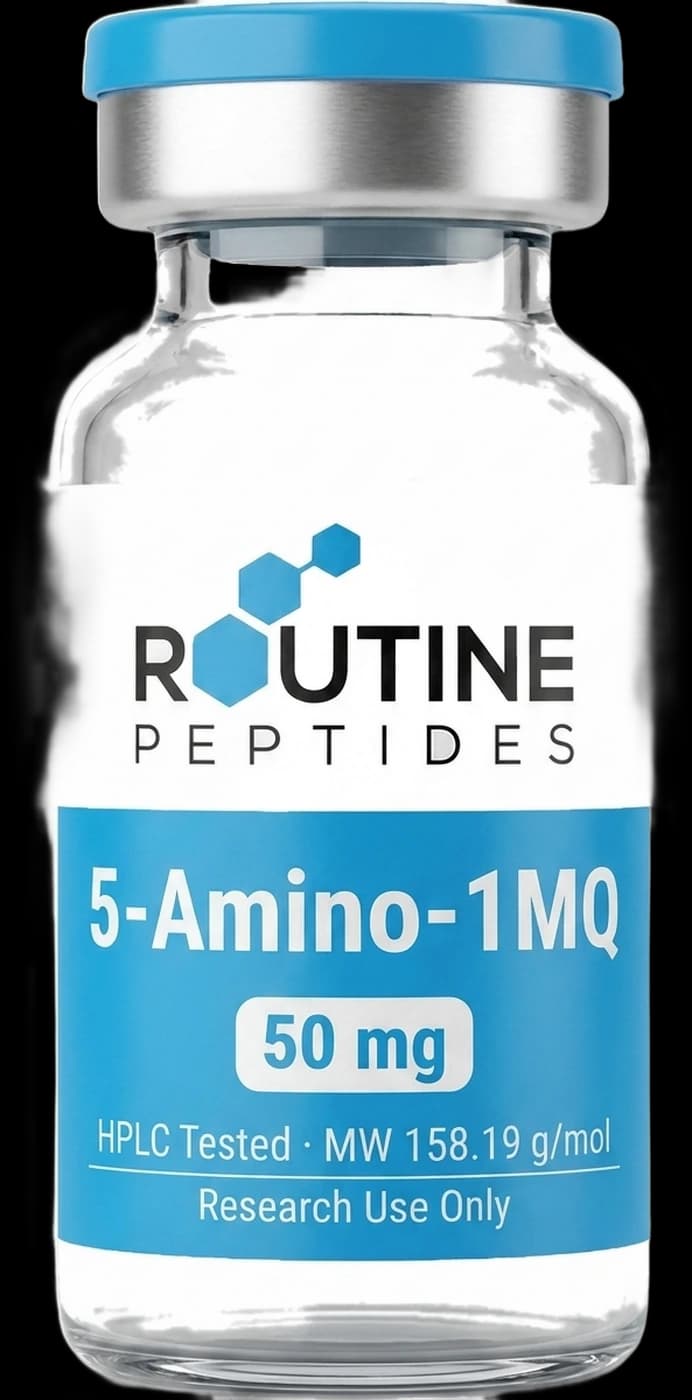
5-Amino-1MQResearch monograph
NNMT Inhibition Studies
This monograph collects what the published literature reports about 5-Amino-1MQ — its mechanisms, the areas it is studied in, its molecular record and the sources behind them. It inhibits nicotinamide N-methyltransferase (NNMT), an enzyme that consumes nicotinamide — the precursor cells draw on to build NAD+. Blocking that consumption is the premise behind its use in metabolic research, where studies typically track NAD+ availability and adipocyte behavior rather than the enzyme itself.
For laboratory research use only — not for human or animal use
Mechanisms
How 5-Amino-1MQ works
Nicotinamide N-Methyltransferase Blockade
NNMT Inhibition
A competitive small-molecule inhibitor of NNMT — the enzyme that methylates nicotinamide and, in doing so, takes it out of circulation. Blocking that step is the whole premise; nothing else about the compound is unusual.
Competitively inhibits NNMT
Lowers 1-methylnicotinamide output
Spares SAM for other methylation reactions
NAD+ Precursor Salvage Pathway Modulation
NAD+ Metabolism
With NNMT inhibited, nicotinamide is reported to return to the salvage pathway rather than being consumed, raising the precursor pool available for NAD+ synthesis. The compound does not supply NAD+ — it is described as reducing a drain on it.
Returns nicotinamide to the salvage pathway
Intracellular NAD+ reported ~1.6x in preclinical models
Acts on NAMPT-dependent synthesis
Adipose Tissue Energy Expenditure
Adipocyte Metabolism
Diet-induced obese mouse models report reduced white adipose mass following NNMT inhibition. This is the endpoint most cited for the compound, and it remains rodent data.
White adipose mass fell in diet-induced obese mice
Food intake unchanged in the same models
Adipocyte gene expression shifted
Studied applications
What 5-Amino-1MQ is researched for
Metabolic Research
Obesity & Adiposity
Diet-induced obese rodent models report reduced white adipose mass following NNMT inhibition. This is the most-cited endpoint for the compound and it remains animal data.
Hong S et al. 2015
NAD+ Biology
NAD+ Salvage Pathway
The proposed route is indirect: blocking nicotinamide consumption leaves more precursor available for NAD+ synthesis rather than supplying NAD+ directly.
Kannt A et al. 2015
Epigenetic Regulation
SAM Methyl Donor Pool
Because NNMT consumes S-adenosylmethionine as its methyl donor, inhibiting it also shifts the methyl-donor pool — which is why the compound appears in epigenetic work at all.
Pissios P. 2017
Insulin Sensitivity
Glucose Homeostasis
Insulin sensitivity endpoints are measured alongside the adiposity ones, generally in the same models rather than as an independent line.
Kraus D et al. 2014
What the published work measures
The endpoints reported across the literature for this compound. The figures belong to the individual papers, not to us.
White Adipose Tissue Reduction (DIO Mice)
Intracellular NAD+ Elevation
NNMT Enzyme Activity Inhibition
SAM Pool Preservation
Reference values
5-Amino-1MQ molecular data
Scroll for full molecular data →
Molecular weight
158.19 g/mol
Molecular formula
C₁₀H₁₀N₂
Physical form
Lyophilized powder
Documented purity
Quantified by HPLC, reported per lot
Storage
-20°C, protect from light
Available sizes
50mg
FAQ
Common questions about 5-Amino-1MQ
What is 5-Amino-1MQ?
+
Unusually for this catalog, 5-Amino-1MQ is a small molecule and not a peptide at all. It inhibits nicotinamide N-methyltransferase (NNMT), an enzyme that consumes nicotinamide — the precursor cells draw on to build NAD+. Blocking that consumption is the premise behind its use in metabolic research, where studies typically track NAD+ availability and adipocyte behavior rather than the enzyme itself.
What is 5-Amino-1MQ researched for?
+
Published research on 5-Amino-1MQ concentrates on Obesity & Adiposity, NAD+ Salvage Pathway, SAM Methyl Donor Pool and Glucose Homeostasis. Each of those areas is summarised further up this page with the citation it comes from, and the full reference list — 4 indexed publications — sits at the bottom. Study designs and concentrations vary considerably between publications, so the primary sources are worth reading directly.
How does 5-Amino-1MQ work?
+
The literature describes 5-Amino-1MQ acting across Nicotinamide N-Methyltransferase Blockade, NAD+ Precursor Salvage Pathway Modulation and Adipose Tissue Energy Expenditure, reported respectively as NNMT Inhibition, NAD+ Metabolism and Adipocyte Metabolism. Those pathways are drawn from preclinical models rather than clinical work, and they describe what has been observed rather than a settled mechanism — the individual pathway cards above cite what each one is based on.
What are the molecular specifications for 5-Amino-1MQ?
+
5-Amino-1MQ has a molecular formula of C10H10N2 and an average mass of 158.19 g/mol. It is indexed under CAS 4213-45-0. It ships as lyophilized powder. Those are nominal reference values for the parent compound. The identity of the specific material you receive is confirmed by mass spectrometry and reported on that lot's certificate.
How should 5-Amino-1MQ be stored and reconstituted?
+
Store the sealed vial at -20°C, protect from light, protected from light and moisture, and let it reach room temperature before opening so condensation does not form on cold powder. Keep reconstituted solution refrigerated and avoid repeated freeze-thaw cycles — solutions are far less stable than lyophilized powder.
Is 5-Amino-1MQ approved for human use?
+
No. 5-Amino-1MQ is supplied strictly for in-vitro laboratory research and development. It is not a drug, food, supplement or cosmetic, it has not been evaluated by the FDA, and it is not intended for human or animal consumption, ingestion, injection or any in-vivo use. Ordering confirms you are a qualified researcher or institution purchasing on that basis.
Cited sources
Peer-reviewed literature
Independent published research indexed from PubMed — not Routine Peptides claims.
Every production run is analyzed by an independent laboratory, and the certificate for your lot travels with the order — not a catalog-wide document, and not a summary written by us.